

The "ONE" Focus
The ONE Focus Section shows a Fine Selection of Artists
that The ONE Museum actively Follows & Supports.
They will obviously be part of our upcoming solo exhibition program.
The high quality of their work and their artistic integrity make them among the best Artists in their discipline.
They are by no means content to tirelessly repeat what Art has already given in the course of its history,
they all have an true story to tell, with their own words, with their own way, but always with an authentic emotion,
they don't lie.
We strongly encourage you to show them all the Love they deserve.
Jean David Nkot
Cameroon
Born in Douala (Cameroon) – where he currently lives and works – Jean-David Nkot is the laureate of several artistic distinctions (Best Sculptor, Best Installation and Best Painter).
“Captivated by the impact of the violence, of indifference and the passivity of the international community and governments on the circumstances of victims in the world, the human body and territories are key subject matters around which the artist centres his works and artistic approach.
Giant post stamps – which constitute a bulk of his creations – interrogate and raise awareness by exploring and exposing faces submerged by inscriptions of the names of weapons of war. Like these postal stamps, the artist’s works act as a vehicle to address victims marked by the violence of indifference which characterizes the complicit face of the world.
Leveraging cartographic techniques, the artist interrogates the representation of the body and its territories in his recent works, placing emphasis on how this intermingles with its surrounding but also questioned its place in society. Far from drawing the attention of the onlooker to the identity of the person represented, the artist highlights rather – in the ways of Zhang Dali, Francis Bacon and Jenny Saville – the expressions of the turmoil inhabiting "his" characters.”


Hardijanto Budiman
Indonesia
Hardijanto Budiman aka. Hardibudi, is a Visual artist based in Jakarta, Indonesia. Photography is for him the best media to express his passion in Art.
He doesn't classify himself as 'pure' Photographer. His works are like the Journey of his life. It is all about the expression of Imagination, Emotion and Experiences of his life.
His favorite genre is Conceptual and Contemporary Photography.
He also loves anything related to Surreal World. That's why a lot of his artworks are strongly influenced with a Surreal touch.
He has won multiple International Awards Winner, more than 200 Awards from many Prestige Photography events around the Globe.
Jean Podevin
1925 - 2011
The child who is already « crazy about textures» at six years of age in the manner in which he selects the sand pebbles to rearrange them better, immediately looks for the balance on the canvas when he begins to paint.
If he happens to try hastily to fix the profile of a table neighbor who caught his eye, he doesn’t hesitate to use a piece of the paper tablecloth on which he eats lunch. Elsewhere, amazed by the beauty of a landscape at noontime, he borrows from the restaurant owner, a felt pencil, to indicate, without losing one second, the essential lines of the view. He will tip a paper napkin in his black coffee to get the very beautiful earth tones that he integrates in the first idea for a canvas painting. The rest would come later in his studio…
...As for me, I felt a sensation of fullness, more or less the one that I often felt before a VERMEER of DELFT while discovering the imponderable light that detached itself from such a picture.
To reach this point, PODEVIN explains how in any case, he must fight to get a perfect understanding between space and volume. But, not more than anyone else, can he analyses with precision this mysterious power that we call « Light « and that pervades every instant of our visual existence…
René BAROTTE - Art Critic
I ignore if he believes « in something «, but I know that PODEVIN can see very far.
Roger BOUILLOT - Art Critic


Onni Wiljami
Finland
Onni Wiljami is an internationally multi-awarded photographer and artist working from Oulu, northern Finland. With nearly 20 years of experience in the photography industry, starting from portrait and documentary photography, he has developed into an expert in detailed and action-packed composite / collage photography.
He’s artworks usually combine the confrontation of man and nature with a surrealistic and fantasy perspective to tell a story that expresses both directly and metaphorically; from surrealistic underwater images one can travel to the spiritual level of life's cross-waves and from dystopic environmental catastrophes all the way to musical narrative. Still, in these dramatic subjects and images, hope or a small hint of humor can be found.
He uses collage technique by combining parts of he’s different photographs seamlessly together; skies and the landscapes, and everything in between, with technical precision for achieving the desired impression. Some parts of the artworks may come from the other side of world and some from as close as home yard. Details from Scotland, the United States, Norway, Italy, or Finnish Lapland for example, can be found in Onni Wiljami’s art blended as a unique fantasy story."
Thierry Lathoud
France
With Thierry Lathoud's photography, we know immediately that there will be no lies, no pretence, no superfluous artifice... Here are sober, sincere, honest, authentic Photography and Art, as much as the artist is himself. In Thierry, one immediately recognizes the man of integrity, in love with photography and who fully dedicates all of his body and soul to it. There is all the seriousness of a photographer who masters the technique, who knows where he wants to go, who owns the art and the way to say things, precisely, with tact and respect, whether the subject is marked by nature or by the human being.
But there is also, and above all, a beautiful poetry that moves me, not a mawkish or imitative poetry, nor is it grandiloquent or outrageous. It is a poetry that is composed, thoughtful, argued and yet emanates directly from the heart, appealing to unfiltered feeling, the poetry of the Seer in the Rimbaldian sense of the term, and when you know that Arthur Rimbaud is by far my favourite author, that is how great the compliment is ! Let me explain: Thierry Lathoud belongs to that privileged caste that can see and feel what the others, us, the common people, cannot see… (read full text: HERE )
Thierry Gulian - Curator of The ONE Museum


Pelly Angelopoulou
Greece / Belgium
My art is about politics, social issues, beauty, love, anger, sadness, physics all come to the forefront as we focus on different parts of the artwork, sometimes even contradicting, not only one another, but the piece as a whole as well. It is a non conceptual art based on concepts .It is my private mythology created by obsessions ,becoming extreme metaphors in fact.
The different materials which in theory are completely out of place turn out to blend in as if they are an integral part of each other. From fabric to stones and from marble to paper we get everyday objects becoming something new and fresh.I deconstruct and reconstruct them in a way to serve my narrations.
What exactly am I doing ? That's the “curse” of defying labels, especially when it is not something forced but on the contrary it is something completely natural. No label..
My last project Π + A , unconventional correlations composed by 115 artworks . It is a result of an unconventional collaboration between the provocative artists Pelly Angelopoulou and Axel Leotard…
Julio Bittencourt
Brazil
Julio Bittencourt grew up between Sao Paulo and New York. His main interest is to, through different stories, investigate the relationship between man and his environment. His works have been exhibited in
museums and galleries in several countries and published in magazines such as Foam Magazine, GEO, Stern, TIME, The Wall Street Journal, Courrier International, C Photo, The Guardian, The New Yorker, Esquire, French Photo, Financial Times, Los Angeles Times, The Huffington Post, LFI and Leica World Magazine, among several others. Bittencourt is the author of three books - ‘In a window of Prestes Maia 911 building’, ‘Ramos’ and 'Dead Sea’.


Taheo Choi
South Korea
Born in 1988 in Seoul, South Korea, the artist lives and works in Versailles, France.
After two years of military service in South Korea, he became involved in the graphic and visual arts. He studied in several institutions and deepened his methods of expression serving multiple inspirations. He graduated from the "Beaux-Arts" in 2019, and is currently pursuing his research on metamorphoses and anthropomorphic figures in tension.
"His work stakes out the boundaries of figuration and non-figuration. From the depth of black emerges the clarity of forms. His works are part of the continuum of the History of Art by synthesizing various aesthetics, but the intensity of feelings remains the spontaneous dynamic of his virtuoso expression.
The ONE Museum is particularly proud to welcome this young and already extremely talented artist to the ONE Museum's group of Permanent Artists. We are absolutely certain that he will have a rich and brilliant career.
Jaya Suberg
Germany
In 1980, I came to live in Berlin, the first 9 years surrounded by the wall… This certainly was the most inspiring time of my life, because of the incredible melting pot of people, who just wanted to live of freedom and independence, not this normal life of just being a family with nice kids and cool car… No, we all had another dream! Living Berlin (the wall time) was/is a blessing! Here we got/get so much inspiration!..
In the center of my artistic expression is the human being between his inner world and his outside world. In my works are melting imaginations, feelings, dreams and the “reality” to one impression. Most of my works shows an intensive human experience or situation. I am more interested in the feelings of mankind under the survive, feelings, which we don’t like to feel, but we carry with us deep inside… some more, some less!.. All is inside-out, all is outside-in.
I understand my work as a mirror of a social present. My works are quite emotional. Feeling all, transforming it and let it go again. Death is for me a very mysterious phenomenon, with all kind of scary feelings. But I want to face it, always aware that life is so precious and will end someday… This refers to my own process as an individual and at the same time to the development of cultural (grievances) processes of the world.


Tatsuo Suzuki
Japan
I was born in Tokyo in 1965, I live in Yokohama and I started shoothing in the streets since 2009 . My aim is to show how the world can be beautiful, interesting, wonderful and sometimes cruel. By means of photography and through my own eyes with my gear, I capture the real world as it is, in each of its unique instants that will never come back. Then, I just offer them to People.
I feel so happy and glad when someone feels some emotion when they see my shots.
These 6 shots were all taken at Shibuya,Tokyo.
DDiArte
Portugal
When we set up DDiArte in 1999, at that time it was a painting workshop where we brought together the best of both of us for the purposes of creation, painting on canvas. In 2003, after several experiences in the field or digital photography, we discovered the ideal means to express our creativity – Digital Photography artistically touched up.
Within the context historiography of art, the use of photography, and more specifically, touching up photographs, is nothing new. We do however aim to innovate somewhat, in terms of the themes on which our work is based. Regardless of the fact that our main source of inspiration is mythology, up-to-date themes or others that are the simple fruit of our creativity, still remain full of details, of symbols, of images, an attempt to captivate, but mainly, as an attempt to stimulate critical thought in viewers.
While some of our work can be seen as satirical in a globalized world, yet still full of differences, other examples can be seen as purely scenic, to be contemplated at will. If some shout out against discrimination, at the same time they pay indelible homage to beauty.


André Perlstein
France
A photographer's biography can be summed up in his eyes. There is an André Perlstein Eye. Since 1967, he delivers his vision of the world and of beings. That of a man whose sensitivity has been forged over time and trials. Nothing has been given to him. Coming from nowhere, he imposed himself as a reporter for L'Express in 1967 and Le Point in 1972 thanks to a very personal reading of current events. He does not take the easy way out. A hunter of the revealing moment, he never rewrites the news. No flashes, a permanent shift so as to never be in the pack of image trackers, an anticipation of gestures and situations through an intimate approach to events and an acute knowledge of their underlying factors. Then, with fashion photography, with Elle and Vital, came the time of aesthetics, of the Perlstein signature, with the will to always find the authenticity of its models and the naturalness behind the glamour.
Denis Jeambar
Robert Houzar
Czech Republic
Manifestation of human existence is the main subject of Robert Houzar’s work. Thanks to the method of a manipulated photography and computer collage, he can take all the mass produced by mankind and handle it completely freely. He works with photographic material taken mainly in big urban conglomerations such as Hong Kong, New York, Buenos Aires, Berlin, etc. High resolution of pictures enables him to create large-format prints with the most delineated details. Robert lives and works in Prague. He exhibits in the Czech Rep. and abroad. His work is represented in collections around the world.


Igor Goryunov
Russia
Born in Siberia and Living in Saint Petersburg, Igor Goryunov studied at the St. Petersburg State University of Culture and Arts. Trained as a videographer, Goryunov draws on the opportunities of digital technology to create a digital art form that perpetuates the fantasies of Gigger in the AI era.
His portraits of ultra futuristic and sensual humanoids in devil's clothing evoke the stroke of Druillet, the delirium of Dantec, transhumanism in all its voluptuous mechanics. Goryunov's creatures swirl with the ease and grace of android dancers, speed lines accentuate their dervish whirl to make them lose their minds ... and they love it.
It is this pleasure of the cyborg in mutation, who sees his body emerge from human finitude to claim the eternity of the gods that the artist captures in a debauchery of nuances, the clever distortion of lines and perspectives, the desired mutation of the pulps and fabrics.
From work to work, Goryunov asserts his power as a modern sorcerer: awakening fascinating golems, taming sirens with enchanting pixels.
Frank Chinea Inguanzo
U.S.A
Frank Chinea is a late neo-romantic artist of the 21st century. He recovers the apocalyptic spirit of those times, stressing his self-observation and his inner experience into his works; he projects the muses and the ghosts of his soul. Black scenarios and stormy views populate his paintings. Diluted figures and dislocated entities emerge from the dark scenarios as his way of presenting his subconscious world.
Expressionistic traits and contorted brushstrokes over thick impasto define his dramatic approach to painting. His works, in the tradition of William Blake or Arnold Böcklin, present heroic figures in abyssal situations. They stand as shadows and specters of gloomy allure. An ethereal background of indecipherable universe sets as a dream like imaginary in which the artist lives. Frank launches angels and demons of an artificial paradise of life and death. He deeps with an excruciating awareness into his psyche and the abyss of his unconscious.
Milagros Bello, Curator


Jan Pruski
Poland
Jan paints to understand a life that is not understandable, it is impossible to pin down. The closer you think you get to understanding a thousand more questions arrive. This is the beauty in what he paints, the impossibility of knowing.
What freedom this is, to know there are always more questions than answers, and always more paintings to come. For the possibility of painting in Jan's world is inexhaustible.
There is almost no blue or green or yellow in his paintings, there is white but it is a winter white, a blanket of white that covers the black and gray and soot and dust of a history so many are running from or trying to bury. This is an internal landscape. A landscape of memory that Jan is not letting us forget, whether it be a personal one or not. How can one move through life without facing life, how can one close the window or the door of memory and truth to smother the noise that we still can hear. I not only see and feel things deeply in the paintings of Jan , but I also, hear them. Even if I close my eyes to forget what I saw it is impossible to quiet the noise of knowing what I saw and felt. These paintings stretch between many worlds and this in one of there many strengths: They are private and at the same time public, they are seen and heard and they are most importantly felt.
In looking at Jan’s painting I try to understand where I am in the painting. Am I looking in or am I inside looking out , or could it be both. Am I locked out or locked inside, is the light inside or outside. I ask this as I look at his painting Pusto nikogo niece ma. Am I walking the stairs from the inside to the outside or the outside to the inside, this ambiguity amps up the tension of knowing where we are and most importantly which is better. Where are we more free? This is always the question of the painter, where are they more free.
Lauwrence Carroll
Wolfgang Stiller
Germany
Wolfgang Stiller has lived on different continents but has now return to Germany and is based in Berlin. His artworks encompass sculpture, drawing and installation, displaying a complicated but subtle interest in bodies and organisms, human and otherwise, via scale, subject and materiality. Stiller‘s artworks have been exhibited in group and solo exhibitions throughout the US, and in Austria, England, Germany, Italy, Ireland, Turkey, China and Japan.
In every work, in each of his series or installation, Stiller enjoys playing of the ambiguity and the duality. This is how he has always considered his studio as a laboratory for artistic research, but in the same time, on a metaphorical level, he sees science as a mirror of society’s moral values. In his early works, which assumed the appearance of abandoned laboratories, or experimentation rooms, the scientists have all gone - or even maybe escaped in the urgency - letting the premises on their own, while in the remnants and residus of human beings passage and work, strange “creatures” can be seen, the question is if they are in a state of decay or “come to being”… Even the material he uses in his art doesn’t escape to the same rule. Whatever it is about those creatures made of industrial metal waste that finally take a very organic look, or the way he used wax which most generally better evokes images of warmth, melting and glowing candlelight than the icy and frozen environment reminiscent to a dripstone cave in his “Industrial Deposit” installation. And again, in his recent “Matchstickmen” installations which focus for the first time on human figures, he plays on two aspects, one, serious if not tragical, being a commentary about the way society treat us and how we treat the others, burning us out as matches, and at the opposite, on a much more playful and humorous approach, almost reckless, like a child could more or less innocently have played with matches and tossed them around.


Paula Rosa
Portugal
Paula Rosa is a designer and visual artist living and working in Lisbon. She showed an early interest for the Visual Arts and Design, which proceeded naturally in her academic training. She graduated from University Lusófona in Equipment and Space Design and from Jean Piaget Institute in Design and Production's Management of Pedagogical Media.
Fascinated by the Visual Arts, from painting to film animation, she has held several solo exhibitions and participated in group exhibitions all over the world. Her work is represented in private collections, museums and institutions in Portugal and abroad.
Combining the technical rigour with the inner chaos of inspiration, Paula Rosa sublimates in the emerging digital art, taken with no prejudice nor frontiers, through the most recent technologies. She divides her activity by an art made of brushes and the discipline of Design; a dualistic option that marks her work and its route.
- - -
Paula Rosa's painting merges the tangible medium of technology with the intangible magic of imagination and dreams. Her work transports us into surreal landscapes and solitary images that stir the emotions of anyone who has ever found themselves empty, lonely or in despair.
She fuses natural and mechanical constructions to explore new and recurring philosophical themes. Her images are thought-provoking and hit at the very core of emotion... in that place where dreams lie and lies torture and joy manages to creep through rocks like persistent little wild flowers.
Julie Laurin
Daniel Mourre
France
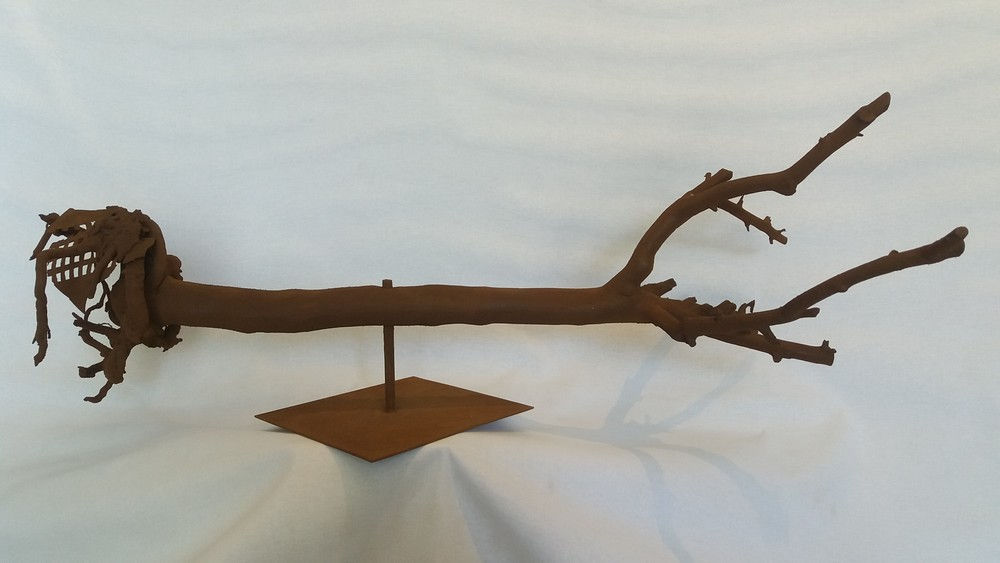
“Daniel Mourre places his work in an era that would be that of a post industrial civilization. He places himself like an archaeologist who would go and trace the footprints of an ancient extinct civilization: ours. Its essential material is alive and completely that of the civilization of metal: Rust. It is an evolving material that offers the surprise of its constant transformations / mutations. His works can be seen as the fossilized footprints of an industrial era that has lost its meaning and has vanished. The pieces he shows, join in their total contemporaneity, a kind of reminder of primitive art. A kind of new art-first post collapse. Both raw and rough. "




Melanie Dornier
France
Mélanie draws her photographic inspiration from the encounter and dialogue with the other. She strives to create a dreamlike and sensitive universe. The notions of identity and trace are explored in the course of projects through a visual narrative imbued with delicacy.
As an observer of social transformation, her aesthetic activism is committed to causes that are close to her heart.
In 2004, she graduated in social work and when she moved to Asia in 2007, she explored documentary photography for over 8 years. The 360° portraits, the reflection of the person, the imprint in their daily life but also their valorization; this is what the author photographer likes to discover and share.
In 2011 her work is recognized as an emerging photographer at the Paris Photography Fair. She then began to professionalise her work, working with the press, galleries and exhibiting internationally. In 2017, she was awarded the Bettye Lane Feminist Award for her work on Indian women. The publishing house Corridor Eléphant then published her first monograph.
That same year, Mélanie returned to France. She has evolved her work towards a more personal approach while keeping the principles of documentary photography and the notion of travel. Through the medium of photography, she explores more personal worlds and allows herself to be carried away by experimentation.